
North Providence Public Schools
1820 Mineral Spring Ave.
North Providence, RI 02904
SPECIAL EDUCATION DEPARTMENT
Teacher Resources
Tools, guidance, and resources for North Providence educators supporting students with disabilities.


Quick Access to Key Resources

What is IDEA?
IDEA Special Education refers to the special education services and protections provided under the Individuals with Disabilities Education Act (IDEA) in the United States. Here's a brief overview: Purpose: IDEA ensures that children with disabilities have access to a free appropriate public education (FAPE) tailored to their individual needs. Eligibility: Children ages 3-22 with specific disabilities that affect their educational performance may qualify for services. Key components: Individualized Education Program (IEP): A customized plan outlining the child's educational goals and necessary accommodations. Least Restrictive Environment (LRE): Students should be educated with non-disabled peers to the maximum extent appropriate. Early Intervention: Services for infants and toddlers (birth to age 3) with developmental delays. Disabilities covered: Include autism, deaf-blindness, deafness, emotional disturbance, hearing impairment, intellectual disability, multiple disabilities, orthopedic impairment, other health impairment, specific learning disability, speech or language impairment, traumatic brain injury, and visual impairment. Rights: IDEA provides specific rights to students and their families, including the right to participate in the IEP process and due process procedures for dispute resolution.
IEP Forms, Guidebooks, FAQs, and Resources
The Rhode Island Department of Education’s IEP resource page provides guidance and tools to support the development of meaningful, student-centered Individualized Education Programs. Educators and families can find information about IEP teams, present levels of performance, measurable annual goals, transition planning, evaluations, and other important components of the IEP process.

Educational Disability Areas & Evaluation Guidelines
Under the Individuals with Disabilities Education Act (IDEA), Rhode Island requires specific evaluations to determine a student's eligibility for special education services. While the following evaluations represent the minimum requirements for determining an educational disability, the evaluation team will determine what additional assessments may be necessary during their deliberations. Pre-Referral Process Before referring a student to the special education evaluation team, schools must implement a problem-solving approach that includes: Regular progress monitoring within the general education curriculum Assessment of the student's response to interventions Documentation of the intensity of interventions in relation to student progress This systematic approach helps ensure that appropriate interventions are attempted and documented within the general education setting before considering special education services. Evaluation Guidelines The evaluations listed below serve as minimum guidelines for determining educational disabilities. The specific combination and scope of evaluations will be tailored to each student's unique circumstances and needs. IDEA Disability Categories The following are the 13 disability categories under which students may qualify for special education services: Autism Deaf-Blindness Deafness Emotional Disturbance Hearing Impairment Intellectual Disability Multiple Disabilities Orthopedic Impairment Other Health Impairment Specific Learning Disability Speech or Language Impairment Traumatic Brain Injury Visual Impairment (including Blindness) Each disability category has specific evaluation requirements and criteria that must be met to determine eligibility. The evaluation team will consider multiple sources of information and various types of assessments appropriate to the suspected disability category. *When a disability is suspected by any educator or family member, they should immediately initiate a referral according to established school and district protocols. It's important to note that Multi-Tiered System of Supports (MTSS) or Response to Intervention (RTI) processes should never prevent or delay the evaluation of a student with a disability. The purpose of MTSS is to provide immediate academic support both before and during the evaluation process, ensuring continuous learning and demonstrating how the student responds to various interventions. This approach helps prevent gaps in the student's education while gathering valuable data about their learning needs.
Resources from the Regional Transition Centers
The Rhode Island Secondary Transition Services and Employment First website provides resources to support students with disabilities as they prepare for life after high school. Educators, families, and students can find information, tools, and guidance related to postsecondary education, employment, training, independent living, and transition planning. The site also connects users with Rhode Island’s Regional Transition Centers and statewide transition supports.


Co-Teaching in Special Education
Co-teaching occurs when a general education teacher and a special education teacher work together to plan, organize, instruct, and assess students in a shared classroom environment. This collaborative approach ensures that all students, including those with special needs, receive high-quality instruction in the least restrictive environment. Models of Co-Teaching 1. Parallel Teaching - Class is split into two groups - Each teacher instructs their group on the same content - Allows for more individualized attention and support 2. Station Teaching - Teachers divide content and students - Students rotate through stations for different learning experiences - Enables small group instruction and differentiated learning 3. Alternative Teaching - One teacher works with most students - The other teacher works with a small group for remediation, enrichment, or assessment - Helpful for pre-teaching or re-teaching concepts 4. One Teach, One Assist - One teacher leads instruction for the whole group - The other teacher moves around the classroom to provide assistance to students 5. One Teach, One Observe - One teacher leads instruction while the other gathers data on students - Useful for monitoring student progress and behavior - Allows for detailed observation of student engagement and understanding 6. Team Teaching - Both teachers share instruction - Teachers interject and build upon each other's points - Creates a dynamic learning environment Best Practices for Successful Co-Teaching Planning and Communication - Dedicate regular time for collaborative planning - Establish clear roles and responsibilities - Maintain open communication about student needs and progress - Share resources and materials effectively Instruction - Use varied teaching strategies to meet diverse learning needs - Implement universal design for learning principles - Provide multiple ways for students to demonstrate understanding - Ensure both teachers are actively engaged throughout lessons Assessment - Jointly develop assessment criteria - Share responsibility for grading - Use data to inform instruction - Monitor progress of all students regularly Classroom Management - Establish consistent routines and expectations - Both teachers should have equal authority - Share responsibility for behavior management - Create an inclusive classroom environment Benefits of Co-Teaching For Students - Increased individual attention - Access to different teaching styles - Reduced stigma for students with special needs - Enhanced peer learning opportunities For Teachers - Professional growth through collaboration - Shared responsibility for student success - Enhanced classroom management - Increased instructional creativity Parents should understand that: - Both teachers are equally responsible for student learning - Their child will benefit from two teachers' expertise - Communication can be directed to either teacher - Co-teaching supports inclusive education practices

Evaluation & Eligibility
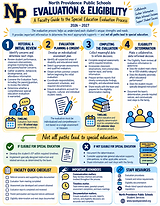
This quick, one-page information sheet provides faculty with an easy-to-follow overview of the special education evaluation and eligibility process. It highlights key steps, required timelines, team responsibilities, and important reminders to support consistent practices and informed decision-making. The resource also emphasizes that not all evaluations result in special education eligibility, but each evaluation helps identify students’ individual needs and guide appropriate educational supports.


